
foto de Gustavo Lemos

Foto de Leonardo Lin

foto de Gustavo Lemos
foto de Gustavo Lemos
MACHO (2015)
Created by Yantó in collaboration with director and choreographer Adriana Grechi (Núcleo Artérias, São Paulo), the dance performance MACHO (Male) emerged from a study on the construction of hegemonic masculinity in contemporary society. The work questions norms, representations and codes of masculinity that are produced and reproduced through different practices and discourses, historically naturalizing certain models of what it means to “be a man”.
Supported by structures such as patriarchy and compulsory heterosexuality, these constructions have historically granted material, cultural and symbolic privileges to men who correspond to dominant standards of masculinity. At the same time, they generate processes of exclusion and violence toward those who do not fit these expectations.
In the performance, Yantó moves through a narrow corridor formed by the audience, shifting through different physical actions and states. The work evokes bodies and experiences considered illegitimate within a cis-heteronormative social framework: almost-masculine bodies, bodies that failed, bodies that refuse the privileges associated with being “macho”. By exposing these tensions, MACHO reveals both the violence and the fragility of these social constructions.
The creative process investigated connections between movement and voice, desire, pop culture and queer imagery, drawing on feminist studies, masculinity studies and queer theory. The work was supported by the ProAC LGBT program in 2014 and premiered in August 2015 at FUNARTE in São Paulo.
Miss The Sea (2020)
After a period away from dance and performance, Yantó created the video Miss The Sea (Miss the Sea / Missing the Sea) during the 2020 quarantine, invited by the project Língua Fora (Leviatã, São Paulo). This work became the starting point for the later performance.
In the scene, a figure wearing a blonde wig, swimming goggles and a crown made of shells is trapped inside a shower box, trying to recreate something that resembles the sound of the sea. Using voice and the noise of cellophane recorded in loops, the character builds an artificial soundscape that evokes the ocean. The Miss, referencing beauty pageant figures, feels the absence of something. What is missing is the sea itself, which she tries to reconstruct through sensations and through a sonic memory shaped by cultural images and stereotypes.
The performance also points to how associations that appear natural are often cultural constructions repeated over time. Just as the sound of the sea can be artificially produced, the femininity embodied by the character also reveals itself as something constructed and performed.
During the action, while assembling her own drag, Yantó simultaneously creates the soundtrack live. The composition emerges from recordings of the voice and the sound produced by friction with cellophane. These materials are captured and processed in real time using loops, reverbs and delays, gradually forming layers that resemble the sound of waves.
By bringing the noise of plastic close to the imagined sound of the sea, Miss The Sea also recalls the presence of plastic in oceans and ecosystems, turning this gesture into a reflection on the contemporary environment.
Miss The Party (2022)
After Miss The Sea, Yantó developed the performance Miss The Party (Miss the Party / Missing the Party), also created at the invitation of Leviatã (São Paulo) for a live showcase in 2022. The work continues the research initiated in the previous project, revisiting the figure of the Miss as a prototype drag character constructed during the performance.
In this piece, the character is connected to the world of nightlife, parties and club culture. Through gestures, costumes and small actions, the figure approaches clichés and stereotypes associated with these environments. However, these characters never appear as finished models. They are defective, broken, sometimes monstrous figures that reveal the tensions and cracks within the standards they attempt to embody.
As in Miss The Sea, the soundtrack is created live during the performance. Yantó records and processes sounds produced by the voice and by the costume itself using loops, pitch shifting, delay and reverb. The layering of these sounds creates a sonic environment that accompanies the gradual construction of the character.
By working with these unstable prototypes, Miss The Party observes how certain models of behavior, appearance and desire are socially reproduced, while exposing their fragility and artificiality.

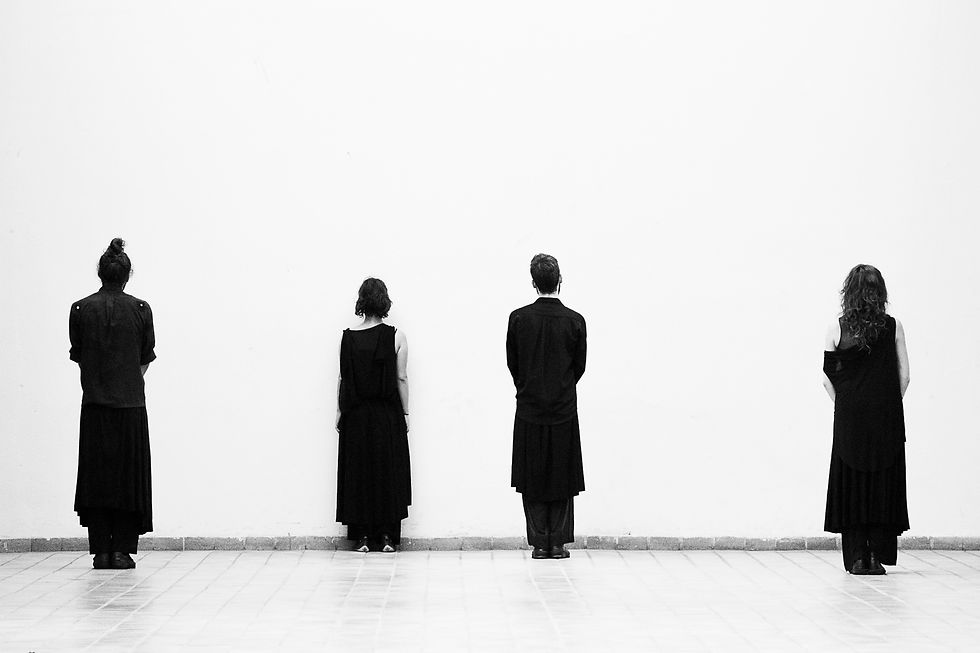

Arquiteturas Sonoras - Grupo NUA (2015)
Sonic Architectures (Arquiteturas Sonoras) was a project by Grupo NUA directed by Yantó that investigated the relationship between body, sound and architectural space. The first version of the work emerged in 2014 during the occupation Yantó & NUA at Oficina Cultural Oswald de Andrade in São Paulo. As the central action of the residency, the group created a temporary performance developed specifically for the building’s main hall, presented in a short run of six performances in December of that year.
After the occupation, the collective continued developing the research and began recreating the work in different architectural spaces. This expansion led to the project Sonic Architectures, supported by the ProAC – Integrated Arts program (2014/2015), which enabled micro-residencies and new versions of the work in Campinas, Botucatu and Caraguatatuba with the participation of local artists.
The project was based on the idea that each architecture has its own acoustic, spatial and symbolic characteristics. The performances emerged from the interaction between the performers’ bodies, live sound production and the specific qualities of each site, transforming the work in every new location.
Grupo NUA – Coletivo Artístico Indisciplinar was active between 2012 and 2017 and worked across the boundaries of theatre, dance, music and performance. The collective included Carolina Holly, Chico Lima, Renata Dalmora and Talita Florêncio, under the direction of Yantó.